

What Lessons About The Human Condition Did Achilles Draw From The Tragic Events Of The Trojan War?
Homer's Iliad describes the final twelvemonth of the Trojan War, a legendary conflict between an alliance of Greek cities and the urban center of Troy in Anatolia. Information technology was probably written in the 8th century BCE later a long oral tradition. The Greeks themselves imagined the war to have occurred former in the 13th century BCE during the Bronze Age.
The Greeks thought Homer was from Chios or Ionia and credited him with both the Iliad and Odyssey, the two masterpieces of Greek literature. They also thought him the greatest ever writer and referred to him simply as 'the poet.' The Iliad is universally acclaimed as a truly great story. There is war and gore, honour and betrayal, pain and pathos, love and hatred, a practiced few villains and even more heroes, all set in the proficient old days of a glorious simply not forgotten by. In a higher place all, the Iliad presents the tragic yet thrilling reality of humanity'south mortality, and equally the events unfold, we are always reminded that our lives are shaped and buffeted by the winds of Fate from which fifty-fifty the central character Achilles, magnificent warrior that he is, cannot escape.
Background
The Iliad, written one-time in the 8th century BCE, is a tragic epic poem of more than than xv,000 lines organised past scholars in Alexandria into 24 books. Book 10 is idea a possible later addition on stylistic grounds, simply it could too exist a deliberate attempt at an intermission in the narrative. Most historians agree that what nosotros have today is the complete original version.
The poem covers a mere 52 days of the Trojan war betwixt a combined Greek super ground forces & the Trojans, protected by the massive walls of their city, Troy.
The poem covers a mere 52 days of the Trojan war between a combined Greek super army and the Trojans, protected by the massive walls of their city, Troy (aka Ilium) in Anatolia. The story and characters were already familiar to its original Greek audience after centuries of oral tellings and retellings. This oral heritage is seen in the repetition of epithets, introductory phrases, fighting descriptions, and mirrored parallel sequences in an e'er-recurring wheel of themes and ideas. The listeners and readers already knew why the state of war started – the Trojan prince Paris has abducted Helen of Sparta and her husband Menelaus has persuaded his blood brother, Agamemnon, king of Mycenae, to class a mighty Greek army to get her dorsum again. They knew the catastrophe, besides, and so the Iliad does not bother with that either. Homer seems more concerned with the universal truths the story can reveal, and then, possibly for this reason, he jumps correct into the story after already nine years of war and siege.
Book ane – Achilles is Seriously Miffed
The Greeks' greatest warrior is Achilles, Mr. Invincible, simply he is now sitting out the war in a big sulk because Agamemnon, 'lord of men,' has stolen his prize, the girl Briseis. His anger and pride will take all sorts of repercussions and almost bring total defeat for the Greek army. Only a tragedy will convince Achilles to fight, sweep the plains of Troy clear of the enemy, and finally run into his own tragic fate. The gods look on with occasional interest and sometimes with direct intervention, but they are immune from the horrors that unfold, and they know it. Both gods and men must ultimately bend to the will of Zeus, the 'Cloud-Gatherer' and king of the gods.
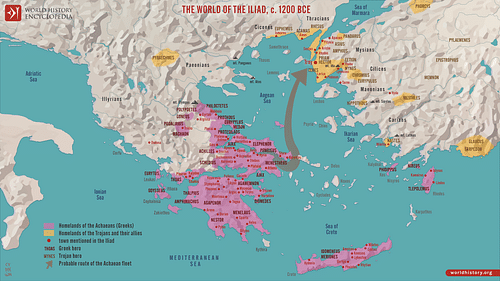
The Globe of the Iliad, c. 1200 BCE
Book 2 – Catalogue of Ships
Agamemnon rashly tries to storm Troy without Achilles, thus making himself even more unpopular with his men. There is a catalogue of ships which lists all the cities taking function in the war. It is long and impressive.
Helen to Hector: 'On usa two Zeus has ready a doom of misery, so that in time to come we can be themes of song for men of time to come generations' (6:357)
Book 3 – The Revenge of Menelaus
'Godlike' Paris challenges Menelaus, 'master of the war-cry,' to a one-on-one fight to settle the war there and and so. Helen bites her fingernails from the walls of Troy as Paris, wearing slightly flashy and inappropriate armour, is soundly browbeaten, but 'quick-glancing' Aphrodite steps in and whisks off the prince in a cloud. The war does non end this 24-hour interval.
Book 4 – Zeus Decides Troy's Fate
The gods contend nearly the progress of the state of war, but Athena and Hera insist that Troy must be destroyed. Zeus consents, simply in return, he will destroy cities of his own choosing and at his own leisure - Mycenae will exist one of them. Meanwhile, the ii armies clash and the plains run with rivers of blood.
Book v – Apollo Repels Diomedes
The fighting continues, and the mighty Greek Diomedes kills all before him. The hero even attacks Aphrodite and Ares, but he finds himself no match for Apollo, the 'far-shooter,' in a scene which reminds of the unbridgeable gulf between gods and men.
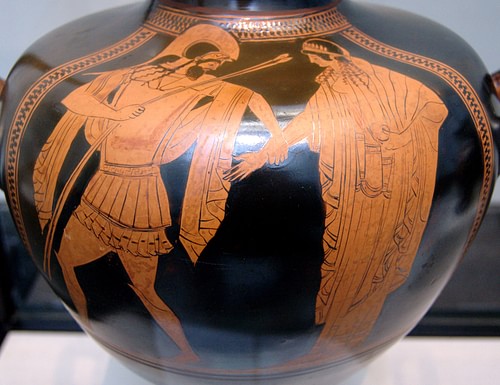
Menelaos & Helen
Book half-dozen – Humanity in War
The fighting on the plains continues and Diomedes meets Glaucus, but instead of fighting, these two champions have a chat and realise they are of mutual descent. They substitution some gifts of armour and office as friends, a piddling oasis of humanity in the pitiless desert of state of war. Meanwhile, within Troy, nosotros come across Hector's wife Andromache to remind united states of america that the Trojans are not dissimilar to the Greeks and their women are equally worried for the future.
Hector: 'And people will say, fifty-fifty men of generations not notwithstanding born, as theY sail past over the sparkling body of water in their many-benched ships: "This is the mound of a human who died long agone. He was the greatest of men, & glorious Hector killed him".' (7:71)
Book 7 – Hector vs. Ajax
Hector, 'tamer of horses,' son of rex Priam and greatest Trojan warrior, challenges whatever Greek to gainsay. Agamemnon persuades Menelaus not to accept, and instead, Ajax, having drawn lots for the honour, marches out to meet the prince. The pair clash but without a decisive blow, and Ajax proves the principal. Darkness and then calls a halt to the fight and they part, once more loaded downwards with gifts. The next solar day a truce is chosen so that the expressionless can be gathered and cremated.
Volume viii – Hector Drives the Greeks Back to their Camp
Slightly fed up that the state of war has not ended by now, Zeus absolutely forbids the gods to intervene this solar day. Hector is magnificent and leads his army in a rousing charge which pens the Greeks back backside their fortified army camp by the shore. Hector camps his ground forces outside the city, such is his confidence in full victory the next day.
Book 9 – Achilles Refuses Agamemnon's Appeal
Things look and so bad that Agamemnon considers throwing in the towel and sailing abode, but he is persuaded to try and tempt Achilles to rejoin the fight past offering him a mass of treasure. Odysseus (wily king of Ithaca and especially smooth talker) leads Phoenix and Ajax who all tell Achilles to call up of the men, their suffering, and the celebrity he can win. Achilles refuses and now loses the moral high ground. His pride will toll many lives.
Book 10 - Reconnaissance
A sort of intermission where both sides hold a coming together and decide to send spies into the enemy army camp to check out their positions and weaknesses.
Book eleven – The Battle Ebbs & Flows
The Greeks come up out of their military camp fighting every bit never before and drive the Trojans back to Troy, just then the tide swings and the Greeks are forced to retreat with many wounded, including Agamemnon and Odysseus.
ARES GOD OF WAR: 'Chosen TERROR & PANIC TO YOKE HIS HORSES WHILE HE HIMSELF PUT ON HIS GLEAMING ARMOUR' (15:113)
Book 12 – The Greek Military camp is Breached
The Trojans, with Hector and Sarpedon leading the way, break downwardly the walls and smash the gate of the Greek army camp. The Greeks panic and flee for their ships.
Book 13 – Poseidon Intervenes
The Greeks receive the help of Poseidon, the 'Globe-Shaker,' and they bulldoze back the Trojans, wounding many and killing fifty-fifty more, including Ascalaphus, the son of Ares no less.
Book 14 – Hera Seduces Zeus
To keep the momentum with the Greeks, Hera, with the help of Aphrodite, distracts and seduces Zeus on Mt. Ida. Hector, meanwhile, is injured past a rock thrown by the now less-than-friendly Ajax.
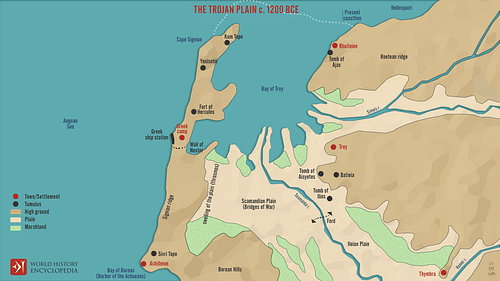
The Trojan Plain c. 1200 BCE
Volume fifteen – Hector'south Finest Hr
Zeus awakens to see the Trojans in peril and forbids any more intervention from Poseidon. Apollo joins the fighting, and with his aid, the Trojans once more drive the Greeks back into their campsite. Hector, enjoying his best twenty-four hours of the war, leads his men to the ships and calls for fire to gear up them all afire.
Narrator: 'As he spoke the terminate of death enfolded him: & his spirit flitted from his body & went on the style to Hades, weeping for its fate.' (16:855)
Book 16 – Death of Patroclus
A key book. Patroclus, best friend of Achilles, remembers the advice of Nestor and begs the great warrior to bring together the fighting and, if not, so allow him to lead the fearsome Myrmidons wearing Achilles' armour. Achilles consents and the fate of his friend and his own is now sealed. The Myrmidons manage to put out the fire amongst the ships, and Patroclus fifty-fifty kills Sarpedon but then rashly charges the Trojans back to Troy. Apollo intervenes and strikes the hero's armour from his torso, and he is killed by the spear of Hector. Now Achilles volition exist really angry. Troy'south fate is too sealed this twenty-four hour period.
Volume 17 – The Body of Patroclus
The two sides fight for the body of Patroclus, just the Trojans win and strip his body. Hector dons the armour of Achilles, but the Greeks renew their efforts and finally manage to take the naked corpse back to their campsite for proper burial.

Achilles & Penthesileia
Book 18 – The Armour of Achilles
Achilles is told of the expiry of his friend and is predictably livid. He swears revenge on Hector. To fight, though, he needs armour, and this is promised him by his female parent Thetis who enlists the master craftsman god Hephaistos. There follows a lengthy description of Achilles' new shield which is decorated with a myriad of fantastic scenes.
Book nineteen – Achilles' Decease is Foretold
Agamemnon and Achilles are reconciled and everyone has a big feast earlier the big boxing of the 'morrow. Achilles knows now that he will die, and information technology will be at the easily of Paris and Apollo, merely revenge drives him on undeterred.
Apollo: '...wretched mortals, who are like leaves – for a time they flourish in a blaze of glory, & feed on the yield of the earth, & and so again they fade lifeless' (21:462)
Book twenty – The Gods Take Sides
Zeus calls for the gods to take their places in the coming boxing. Ares, Artemis, Aphrodite, and Apollo will help the Trojans while the Greeks accept Hera, Poseidon, Hermes, and Athena. Battle commences on the plains. Achilles sweeps all before him, but Hector is saved from a confrontation by Apollo who whisks him away in a cloud.
Volume 21 – Achilles & Xanthos
Achilles is still chopping away at the Trojans and numberless himself 12 captives to slaughter after at the funeral of Patroclus. He drives so many of the enemy into the river Xanthos that the river god rises in indignation and chases Achilles back to the Greek camp. The gods begin fighting each other in a painless and inconsequential parody of the more vicious boxing on the manifestly. Meanwhile, the Trojans are driven dorsum, and all abscond into their metropolis, all except 1: Hector, who makes a stands at the Skaian Gates.
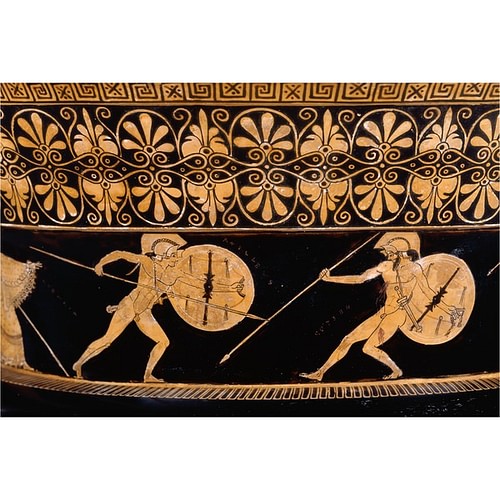
Achilles Fighting Hektor
Book 22 – Achilles vs. Hector
Hector, blaming himself for his own stupidity and camping ground out on the plains instead of safely inside the city walls, prepares to meet his fate. Priam bites his fingernails from the walls of Troy every bit he sees Achilles arroyo in his gleaming armour. The sight of the great warrior speeding towards him causes Hector to flee, and the pair indulge in a hunt around the city three times. Zeus then weighs the golden scales of Fate and Hector's side sinks. 'Swift-footed' Achilles catches his man and sends him to Hades with a single spear strike to the throat. Now Troy really is in problem. Shockingly, Achilles ties the body of Hector to his chariot and drags him ignominiously dorsum to camp.
Achilles: 'This is the fate the gods have spun for poor mortal men, that we should live in misery, but they themselves have no sorrows' (24:525)
Book 23 – Funeral Games for Patroclus
Having got his revenge, Achilles now sets about honouring Patroclus with some funeral games which include chariot races and prizes for all the winners. Information technology is a break for anybody before the emotional drama of the terminal book.
Book 24 – Priam's Appeal
The gods are angry at Achilles' disrespect for the body of Hector. Thetis is sent to appeal to him. At the same time, Priam is helped by Hermes to magically appear in the Greek camp on his own mission of mercy. Achilles bows to Priam's moving spoken language and releases the body of Hector for proper burial. Here the Iliad ends.
What Happens Adjacent
The demise of Hector is Homer'south metaphor for the fall of Troy itself as the Iliad'due south story ends here, if not the bodily war. We even so have to come up battles with Amazons and the death of Achilles, felled by an arrow to his heel from Paris' bow. Paris is shot by Philoctetes, and Ajax goes mad and slaughters a load of sheep before committing suicide afterward not getting the armour of Achilles. And so, after the Trojan Horse ruse to gain entry into the urban center, Troy finally falls and is ruthlessly sacked.
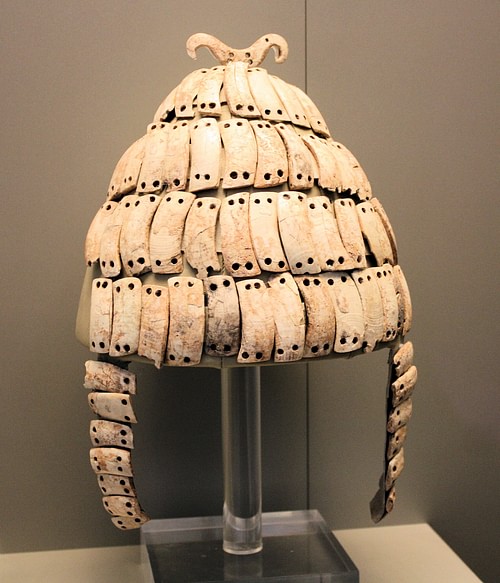
Mycenaean Boar'south Tusk Helmet
Myth & Reality
The archaeological site of Troy in Anatolia, first excavated by Heinrich Schliemann in the belatedly 19th century CE, has revealed a urban center with a history of domicile over thousands of years. Of the several cities built on superlative of each other, Troy Vi (c. 1750-1300 BCE) is the most likely candidate for the besieged city of the Iliad. Impressive fortification walls with several towers certainly fit the Homeric description of 'strong-congenital Troy.' The lower town covers an impressive 270,000 g² and suggests a yard city like the Troy of tradition. Bronze arrowheads, spear tips, and slingshots have been found at the site and fifty-fifty some embedded in the fortification walls, suggesting some sort of disharmonize. These engagement to effectually 1250 BCE which correlates with the traditional appointment for the Trojan War.
Conflicts over generations between the Mycenaean and Hittite civilizations are more probable, colonial expansion and command of lucrative trade routes beingness prime number motivators. While such conflicts are unlikely to have been on the scale of Homer's state of war, collectively, they may well take been the origin of the ballsy tale of the Trojan State of war which has fascinated for centuries.
This article has been reviewed for accuracy, reliability and adherence to academic standards prior to publication.

Source: https://www.worldhistory.org/iliad/
Posted by: gibsonthistalre98.blogspot.com
0 Response to "What Lessons About The Human Condition Did Achilles Draw From The Tragic Events Of The Trojan War?"
Post a Comment